
Harmon Builders presents a blog post from Riyam Al-Janabi, who attends the Architecture program at Norwich University in Vermont, along with our son, Jesse Harmon. We are pleased that Riyam is an intern working with HB currently and the post below details a project on which she, Jesse and Rylie Harper were team leaders.
Introducing Myself
I am Riyam Al-Janabi, I recently graduated with a bachelor’s degree in architecture and very glad to have the opportunity to intern at Harmon Builders. Before architectural school at Norwich University in Vermont, I always enjoyed painting portraiture focusing on emotions within facial features.
Along with my interests in architecture, I thought about how I can implement displaying emotions through design and buildings. Unlike painting on canvases, architecture forms shapes to create a space which influences your emotions and mental cognition.

Riyam Al-Janabi
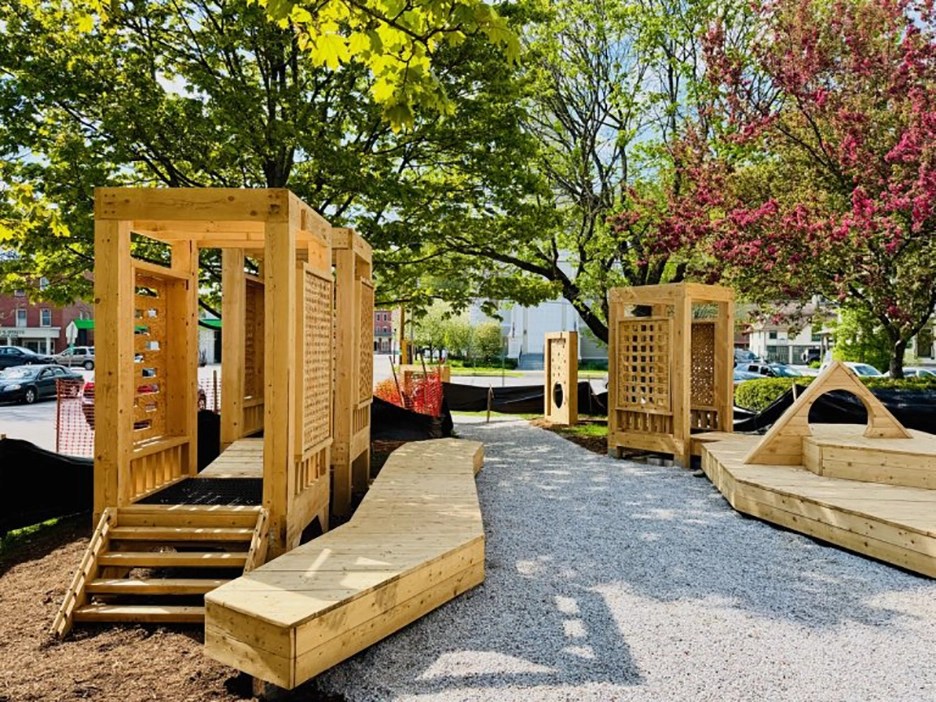
Senior Capstone Design/Build Project
The Norwich University Design+Build studio has designed and built the Little Rapids Playscape just outside the Kellog Hubbard Library in Montpelier Vermont.
This playscape goes beyond slides and swings, it encourages imagination and character development of both children and adults. Although we don’t instantly see this influence on our minds, it’s embedded and comes from experience within the structure itself.
The memories created, games played, moments spent alone and with others, and simply observing interactions, influence our perception and understanding of our own personalities, cognitive abilities and social behaviors. This playscape extends the children’s program into the entire community of Montpelier, serving people of all ages and ability levels with fun things to enjoy!


Designing and Building the Playscape
Our class led by professor Tolya Stonorov had worked collaboratively collecting community feedback, designing, and building the play structure to meet their needs and desires.
Jesse Harmon was the team leader of the high structures (see photo). He focused on a design with high mobility allowing the child to test their abilities and hone their creativity and cognition.
Each panel (panel examples above) serves as an abstract interactive surface, allowing users to interpret and engage with it in their own unique way, either independently or with others.
In addition to producing detailed construction drawings before and during the building phase, his team created the digital files used by a CNC (Computer Numerical Control) machine to fabricate all of the interactive panels installed throughout the play structures.
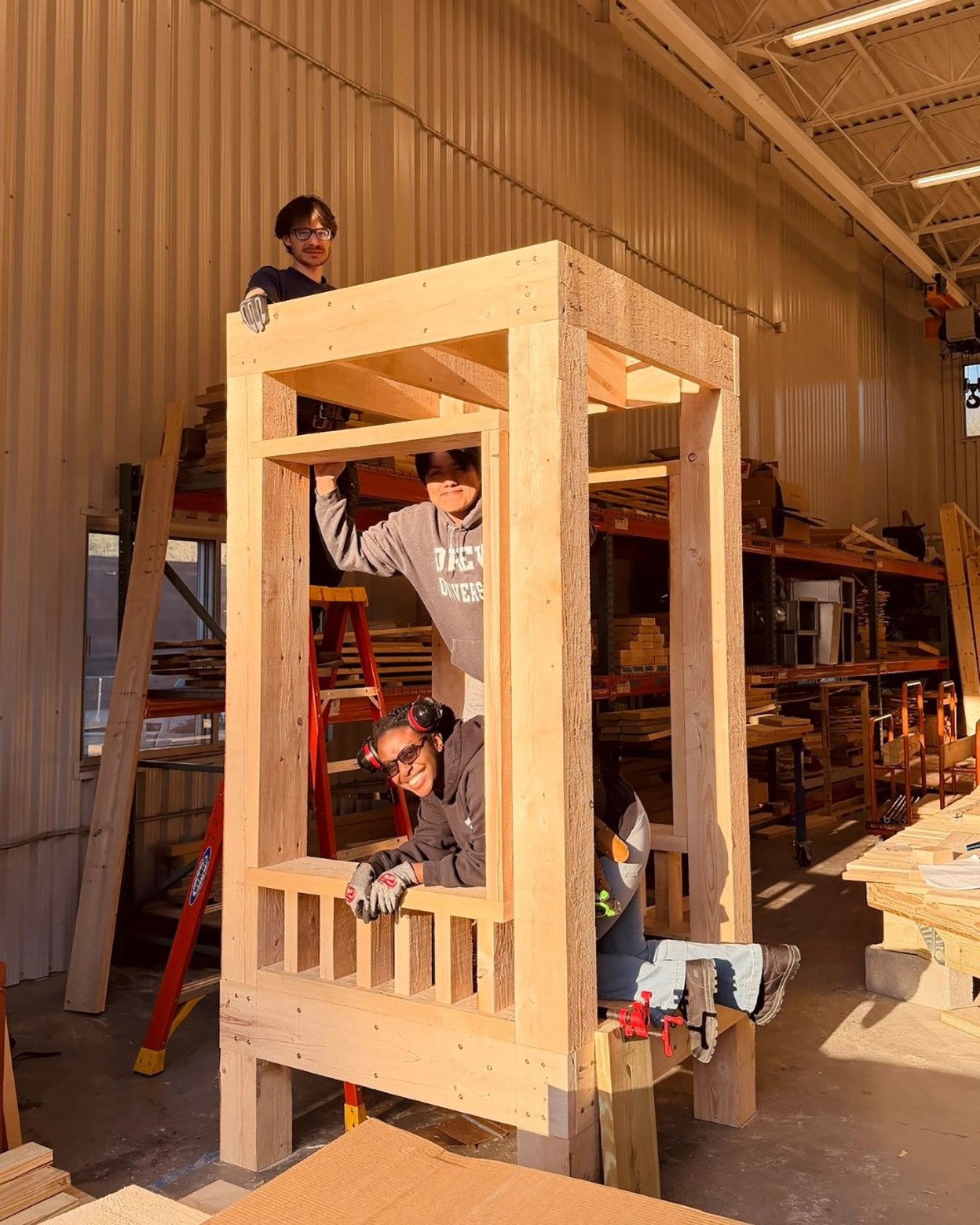
Jesse, team lead on High Structures, on top
Rylie Harper, was the team leader of the Interactive Wall Modules. The structures were designed to be interacted with in various ways, not limited by one’s physical abilities—climbing, walking through, rolling cubes, hiding behind, sitting or standing in front or behind, crawling, jumping over, and simply moving around.
Built along the path of the playscape, the installation attracts and filters people as they approach, guiding them into the rest of the modules. It does not force immediate interaction; instead, it allows users to speculate on possible uses within its features while still maintaining a connection to the surrounding structures.
Rylie managed both the design and construction of these modules with his team, producing detailed assembly drawings and collaboratively building the panels for on-site installation.

Team Leaders
I was team leader of the Medium Structures portion of the project. These structures are designed in harmony with the High Structures portion and are inspired by abstract granite crystals. Their form encourages a variety of activities and allows people of all ages to engage with and enjoy the space: picnicking, socializing, running, biking, climbing, walking, and even gymnastics.
As part of the mission, I worked alongside Jesse, other project managers, professor Stonorov and other colleagues to produce the required documents to understand and build the playscape within eight weeks, excluding the design phase in January and February.


From Design Documents to Construction
As I live in Vermont, I stayed on to help with the final touches alongside Tolya Stonorov. This included installing the interactive panels, similar to those Jesse installed, as well as applying protective coatings to all exposed wood surfaces of the play structures. The project was transported to the site in early April and completed in May 2026.
One of the most challenging tasks for me was creating the cut sheets, which guide the cutting of the exact wood pieces needed to assemble the structure from the ground up.


Because each piece requires multiple angled cuts and must be positioned at specific angles within the structure, I found that having a complete list of dimensions and measurements, alongside representation drawings, was much more efficient than relying on drawings alone.
Drawings within a CD set are meant to clarify and help us understand where each piece is placed and how it functions within the overall assembly. They must be readable and procedural so others can effectively use them. The cut sheets required a significant amount of math, so I completed them by hand using simple calculations on paper. This approach helped speed up the process while reducing confusion and minimizing the potential for errors.
Lessons Learned
In contrast, the High structure was more straightforward in its geometry, which meant it relied more on detailed representation drawings and production files rather than mathematical cut sheets like the ones I developed. The project wasn’t easy and I’m grateful to everyone who supported and guided me throughout the process and the semester.
Please check out the Norwich article about the playscape for more details.
*Photos courtesy Norwich University Design+Build program


See complete project information below on Norwich University’s Playscape for The Kellogg Hubbard Library (embedded).
Note: if you have any problems scrolling below, select the full-screen icon and try again.